

by Nigel Ong
Espresso drinkers usually seek deep, dark, and bold flavors with their coffee. This made roasters roast their coffee extra dark for them. Starbucks also offers its own take on espresso roasts, with the Starbucks Espresso Roast.
However, how good is it? Will it be another case of ‘Charbucks,’ where the beans are roasted to be so smoky you simply taste nothing else? Let’s find out.
In this post, I grab myself a bag of the Starbucks Espresso Roast. Then I brew it several ways and see how the coffee tastes. Finally, I compare the Starbucks Espresso Roast with other espresso roasts and other dark roasts from Starbucks.
About Starbucks Espresso Roast
Starbucks Espresso Roast is one of the longest blends it offers. Introduced in 1975, it remains one of the most popular roasts in Starbucks’ lineup. It is also one of their best sellers.
The Starbucks Espresso Roast is blended from the high-quality fusion of Arabica coffee beans from Latin America and Asia Pacific. This helps to create a balanced espresso blend.
These beans are also roasted deep brown with an oily gloss outside. This should help to bring in a strong, full-bodied espresso with caramel sweetness and smoke.
On Starbucks’ scale of coffee roast darkness of 4-12, the espresso roast is at a pretty high end of the scale, suggesting it is a very dark roast. It has a roast intensity of 11.
The coffee bag I have for this review is designed for the Asia Pacific market. The packaging is slightly different in the US, but checks with the barista show that they are roasted to the same standard.
How Does Starbucks Espresso Roast Taste?
Since this is an espresso roast, we can all tell it is only meant for one thing – espresso. I’ll skip other brewing styles I usually do and just go straight into espresso with this review.
I’ll also use the espresso as a base to make other drinks and see how they taste. These include Latte, Macchiato and Americano.
First Impression
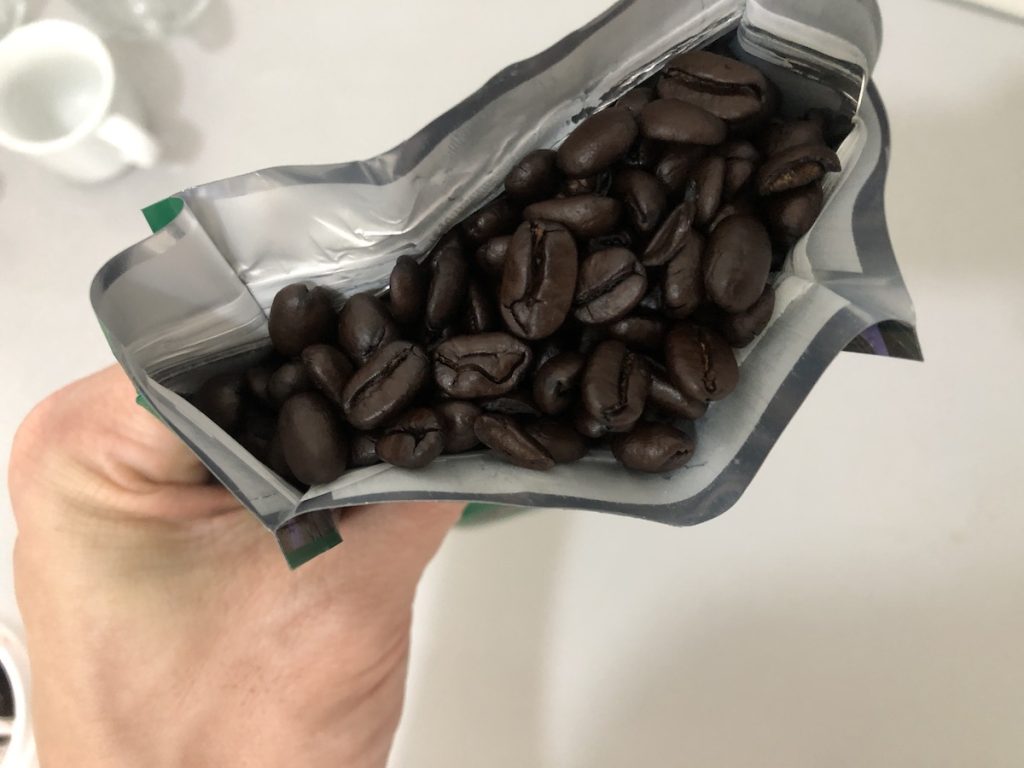
When I tore open the coffee bag, I saw dark glossy beans, just like how espresso roasts should look. This is an espresso roast that is not shy to be one.
However, I think the shine is still manageable. I have seen shinier coffee beans than this one, and my concern with really shiny coffee beans is how they may clog up coffee grinders. However, I think it’s still ok with the Starbucks Espresso Roast.
The coffee has a pleasant aroma. I smell some sweetness, possibly caramel. There’s also some sourness. I won’t describe it as citrusy, but just a general sourness. I suppose this would be an acidic espresso roast.
I compared the beans with another espresso roast I have in hand, the IKEA Patar Espresso Roast. It seems that the Starbucks Espresso Roast has slightly shinier beans. This should mean it has more flavor than the IKEA Patar Espresso Roast, but let’s see.
Espresso
All right, time to start pulling shots. I turned to my trusty Wacaco Minipresso GR for this. I loaded 8 grams of fine ground and about 30ml of hot, off-boiling water and pumped a shot.
I love what I see. The smell of espresso fills my kitchen. The espresso produces rich, thick crema that looks very inviting. I brought the espresso closer to my nose; there was not much smoke or charred smell with the espresso too.
I took a sip, carefully ensuring I sipped enough coffee, crema, and air. What I get is an airy espresso with a bold flavor. It is strong and comes hard on my palate. However, unlike cheap espresso roasts, I would not say it is just bitterness and smoke.
I get to taste some sourness, likely the acidity from South American beans in the blend. Once I swallowed the espresso, my tongue caught some bittersweetness, possibly dark chocolate.
As I sipped along, I also picked up a bit of caramel sweetness, especially if I let the espresso linger on my tongue a little longer. This is not hard to do, as the espresso is not too strong to the point you only want to gulp it.
The crema is thick and rich and remains with the espresso as I sip. To me, this is a deep and satisfying espresso.
Americano
Now that we know the Starbucks Espresso Roast can hold its own, I thought I’d go ahead and try to make espresso-based coffee drinks, using the espresso as a base.
To start, I thought I would work with just water and dilute the drink. I was deliberating between Americano or Long Black, but I opted for the earlier. The reason? It’s more popular.
I brewed a shot of espresso and added two shots of hot, off-boiling water to break the crema up. The results? A strong cup of coffee, but with very sippable attributes.
The Americano seems to make the coffee taste a little bit more sour. I do not think the water made the coffee more acidic, but if you enjoy sour notes on your coffee, this will be very enjoyable.
The slight caramelized sweetness also pops here in the Americano drink. You may notice it more as an aftertaste after you swallow the drink.
Macchiato
I thought the next natural step would be to experiment with some milk. In this case, I started with a Macchiato. If you are unsure, this is a simple recipe where a shot of espresso has a dash of milk added to it.
I heated my fresh UHT cow’s milk in a microwave and poured it into my IKEA Mattlig Milk Frothing Jug. Then, I frothed the milk using the IKEA Produkt Milk Frother.
This combination costs less than $20, a cheaper alternative to buying a coffee maker with a milk steamer. Try this combination if you don’t have a milk steamer at home.
When that was ready, I pulled a fresh shot and poured a small dollop of milk into the espresso. Excuse me for the bad pour; I wasn’t good enough on that yet.
The milk also added some white color to the crema, making it a nicer drink to look at too.
Taste-wise, the milk improved the coffee, at least in my opinion. It softens the espresso and makes it less ‘punchy’ and bold. I also noticed the drink became less acidic, softening the espresso.
The milk also helps to sweeten the espresso slightly; perhaps the lactose in the milk helped with this.
Latte
Next, I made a cup of Latte out of the espresso. I decided to make a latte over cappuccino because it is generally more popular.
I used the regular latte formula of one part espresso and three parts milk, with a thin foam layer on top. Once again, the pour is a simple blob, just nice for someone unskilled like me.
The rich milk softens the punch of the espresso further and replaces it with smooth, milky richness. The sweetness from the lactose is also more prominent and makes the cup very enjoyable to drink. No wonder Latte is so loved by many.
However, it does not drown out the coffee. You can still enjoy the deep, cocoa-like bitterness of the espresso and some of the smoke.
I was tempted to continue sipping the Latte. Still, I held back, saving my caffeine quota for further tasting. I also don’t want to saturate my palate too quickly.

Starbucks Espresso Roast vs. IKEA Patar Espresso Roast
I decided to also compare the taste of the Starbucks Espresso Roast and the IKEA Patar Espresso Roast. Since they are both espresso roasts, they may make a good comparison.
I brewed a shot of espresso from each roast and sipped them side-by-side. After the first sip, I would say that the IKEA Patar Espresso is slightly sour. It also has less smoke and more clarity in flavor compared to Starbucks.
When I say clarity here, I can pick up flavors easier with the IKEA Patar Espresso roast.
The Starbucks’ Espresso Roast is smokier and less sour. It also hits your palate stronger and has a stronger bittersweet cocoa note. I also think the Starbucks’ Espresso Roast has a longer finish – the flavor stays on your palate longer after you swallow it.
The IKEA Patar may be a better choice if you like less smoky and bold espresso. However, if you seek nothing but the hardest, smokiest coffee hits, the Starbucks’ Espresso Roast would be it for you.
Starbucks Espresso Roast vs. Regular Espresso
If you are the type that likes to order espresso from coffee shops, you should find the Starbucks Espresso Roast a good replacement.
In most cases, cafes serve espresso blends designed to please as many tongues as possible. This means these espresso roasts are balanced in flavor, without too much smoke and the acidity of certain flavor notes.
You will get the same with the Starbucks Espresso Roast. It should not offend too many palates, as it is quite balanced. Its slight acidity may turn you off, but I do not think many drinkers will care.
Suppose you have basic espresso tools at home. In this case, you should be able to recreate a cup of deep, rich, and dark espresso at home, similar to your regular cafes, with the Starbucks Espresso Roast.
Who Should Enjoy Starbucks Espresso Roast?
If you enjoy espresso, you should be able to enjoy the Starbucks Espresso Roast. This is because it makes a good, balanced espresso with all the expected flavors.
The espresso also does not offend, as it is not too edgy in flavor. Some gourmet espresso could focus on acidic, smokey, or earthy flavors; it may be too much for regular drinkers. You should not feel like this with the Starbucks Espresso Roast.
The Starbucks Espresso Roast’s inoffensive, comfortable nature also makes it an excellent place to develop your taste preferences.
Start with this roast, and as you develop a preference for more smoke or earthy notes, you can always look for an espresso roast with those notes.
If you like a deep and rich cup of Latte, Cappuccino, Cortado, or Mocha, consider using the Starbucks Espresso Roast as the base too. This is because its deep, rich, bitter cocoa taste should blend well with the sweetness of the milk.